

Sheep are not silent when they stop bleating
Sheep are not silent animals. Even when they are not making noise, they are communicating. They communicate with posture, distance, movement, alertness, ear position, flocking behaviour, isolation, hesitation and routine.
Many of these signs are easy to miss because they are subtle. But for a shepherd, those small changes can be the first warning that something is wrong. The farmer who only listens for bleating misses most of the conversation.
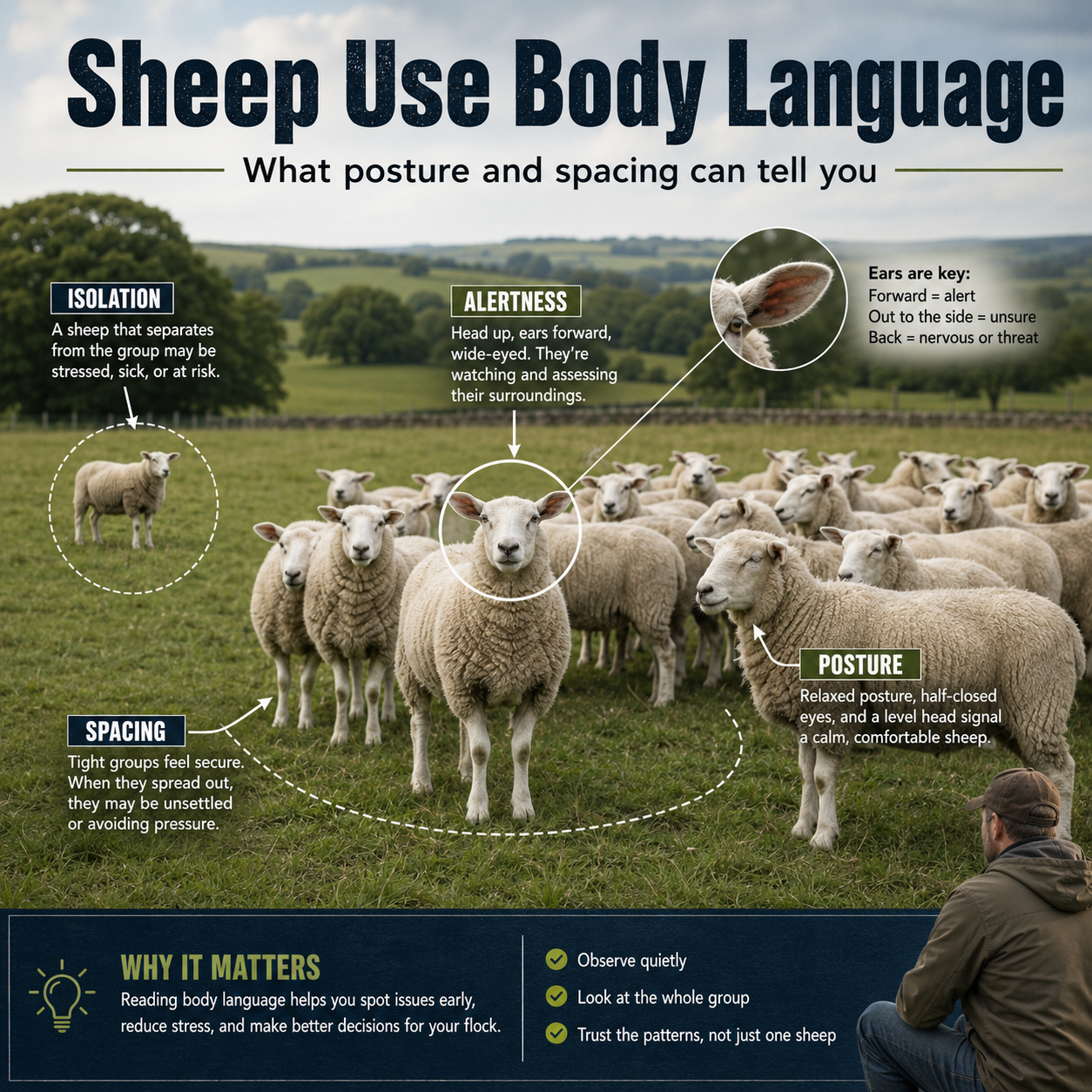
Sheep are visual communicators
Sheep use many visual signals. They react to movement, space and body posture. A calm flock may spread out to graze. A flock that feels threatened may bunch together, lift heads, become alert and move as a group.
A sheep that is relaxed behaves differently from a sheep that is unsure. A sheep that is in pain may behave differently from one that is simply resting. A sheep that isolates itself may be showing a sign that something is wrong.
Why sheep hide problems
Sheep are prey animals. In nature, showing weakness can make an animal more vulnerable. This is one reason sheep may not show clear signs of pain or illness until a problem is advanced.
- A sheep may stand slightly away from the flock.
- It may stop coming forward to feed.
- It may lie down more than usual.
- It may walk with shorter steps.
- It may hold its head differently.
- It may stop ruminating normally.
- It may be slower to rise.
These are not diagnoses. They are signals.
Isolation is important
One of the strongest warning signs is a sheep that separates from the group without a clear reason. Sheep are flock animals. They normally prefer group safety. A ewe may isolate near lambing, and some temporary separation can be normal depending on the situation.
But a sheep standing alone repeatedly, not grazing with the others or staying behind when the flock moves should be watched closely. Isolation can be linked with pain, fever, lameness, digestive problems, lambing issues, weakness or social stress.
Feed behaviour tells a story
Feeding time is one of the best times to observe sheep. Healthy sheep usually show interest in feed. They may not all behave the same, but each animal has a pattern. Some are pushy. Some are quiet. Some always arrive first. Some wait at the edge.
A problem often begins when that pattern changes. A sheep that usually comes forward but suddenly hangs back may be sick. A lamb that stops competing may be weak. A ewe that eats slowly or drops feed may have mouth or dental issues.
Movement is body language too
A sheep’s walk can reveal pain before you catch it. Watch animals moving freely. Look for uneven stride, head bobbing, reluctance to bear weight, kneeling, difficulty rising, stiffness or lagging behind the flock.
Lameness is not always obvious. Early lameness may look like a small hesitation. But small foot problems can become major welfare and productivity issues if ignored.
Resting is normal. Too much resting is information.
Sheep rest and ruminate. That is normal. A healthy sheep may spend long periods lying down and chewing cud. So lying down alone is not a problem. The question is whether the pattern is normal.
- Lying down more than usual
- Difficulty rising
- Repeated lying down and standing up
- Grinding teeth
- Resting away from the group
- Not ruminating while resting
- Head low and dull expression
Routine makes observation easier
The more routine a flock has, the easier it is to notice change. Feed at similar times. Walk through calmly. Watch before disturbing them. Learn which animals are bold, shy, dominant, slow, nervous or quiet.
When you know normal behaviour, abnormal behaviour becomes visible. This is why small flocks can have an advantage. A farmer with 20 sheep can learn every animal, but only if they actually watch them.
A simple daily observation routine
- Stand quietly and observe before entering.
- Check whether the flock is spread normally or bunched unusually.
- Look for any animal standing alone.
- Watch movement as they walk.
- Observe feeding behaviour.
- Look for coughing, diarrhea, wool loss or wounds.
- Notice animals that do not respond normally.
Final thought
Sheep communicate constantly. Not always loudly. Not always clearly. But they show signs through movement, posture, spacing, feeding and routine. A good shepherd does not only count sheep. A good shepherd watches them.