

A tighter supply year for Australian sheep
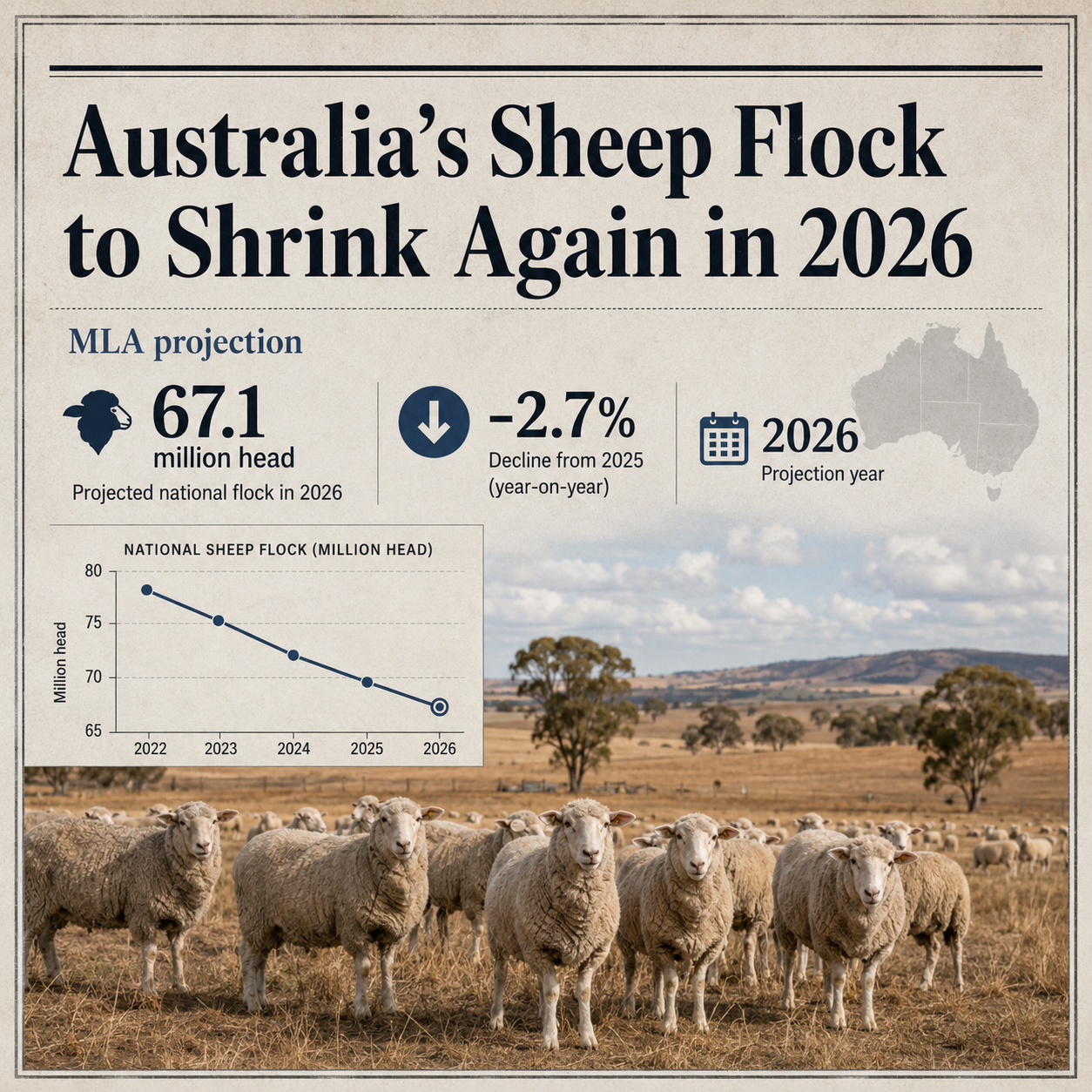
Australia’s sheep industry is heading into another year of tighter supply. Meat & Livestock Australia’s March 2026 Sheep Industry Projections estimate that the national sheep flock will fall to 67.1 million head by 30 June 2026, a 2.7% decline from the 2025 estimate.
For farmers, processors and exporters, the headline is simple: fewer sheep, tighter availability and a slower rebuild. But the story is not only about the number of animals. It is also about seasonal pressure, ewe retention, slaughter volumes, carcase weights, breeding decisions and how long it may take the national flock to recover.
What MLA is projecting
According to MLA’s 2026 sheep projections, lamb slaughter is forecast at 21.86 million head in 2026, down 11%. Mutton slaughter is forecast at about 7.13 million head, down around 30%. Lamb production is forecast at around 537,000 tonnes carcase weight.
The key point is that slaughter numbers are expected to fall more sharply than the total flock number. This suggests that many producers are holding onto more core breeding stock where possible, rather than continuing heavy turn-off.
Why the flock is shrinking
MLA links the decline mainly to the cumulative impact of difficult seasonal conditions and heavy turn-off. Dry conditions across key southern production regions have placed pressure on pasture, fodder and producer decision-making.
When feed is short or expensive, producers often have to make hard decisions. Some reduce stocking rates. Some sell lambs earlier. Some sell ewes they would normally keep. Some delay rebuilding until conditions improve. Those decisions can protect the farm in the short term, but they reduce the number of breeding animals available for the future.
Heavy turn-off has a long tail
The effect of heavy turn-off does not end when the dry period ends. If too many breeding females are sold, the flock cannot quickly rebuild. If ewe lambs that might have entered the breeding flock are sold for slaughter, next year’s production base becomes smaller. If pregnant females are turned off under pressure, the impact reaches the next lamb crop too.
A flock can shrink quickly, but it cannot rebuild instantly.
Lower slaughter does not mean weak production efficiency
One important detail in the MLA projections is that production does not fall as sharply as slaughter. Lamb slaughter is forecast to fall 11%, but lamb production is forecast at around 537,000 tonnes carcase weight. This is still historically strong compared with many earlier years.
The reason is productivity. Heavier carcases, genetic improvement, feeding strategies and processor demand for heavier stock can support output even when head numbers fall. In plain language: fewer lambs may be processed, but each lamb may be heavier on average.
What tighter supply means for farmers
For sheep farmers, tighter national supply can affect several decisions. Ewe retention becomes more important. Replacement planning becomes more expensive. Feed decisions matter more. Poor performers become harder to justify. Market timing becomes more sensitive.
In a tighter supply year, the animals retained on the farm need to be the right animals. Keeping every ewe is not the same as rebuilding well. Holding lambs longer is not automatically profitable if the feed cost and growth rate do not work.
What it means for the wider market
Processors may face fewer available animals. Exporters may have tighter volumes. Buyers may compete more strongly for certain classes of stock. Domestic supply can also feel the effect. However, lower supply does not automatically mean easy profit for every farm. Costs, season, carcase weights, freight, currency and market access still shape the final outcome.
Small flock lesson
Even outside Australia, the lesson is useful. A flock can shrink quickly but rebuild slowly. Selling too many females during pressure periods can limit future production. Feed pressure exposes weak management. Market changes reward farmers who know their animals, costs and timing.
Final thought
Australia’s projected flock decline in 2026 is not only a market statistic. It is a reminder of how tightly seasonal pressure, breeding decisions, feed availability and long-term production are linked.