

Quarantine for New Sheep: The Cheapest Disease Control Habit
Why new sheep should not go straight into the flock
Bringing a new sheep into the flock is exciting. It may be a better ram, a promising ewe, a few replacement lambs, or an animal bought because the price looked right.
But the riskiest moment in many small flocks is not lambing, feeding or shearing.
It is the moment a new animal walks through the gate and joins the rest of the sheep too quickly.
A new sheep can look healthy and still carry a problem. Some diseases, parasites and foot problems are not obvious on the first day. Stress from transport can also make hidden problems appear later. By the time the signs are clear, the animal may already have shared water, feed, bedding, fences, trailers and close contact with the whole flock.
That is why quarantine is one of the cheapest disease control habits a sheep keeper can use.
What quarantine means
Quarantine simply means keeping new arrivals separate from the main flock for a period of observation.
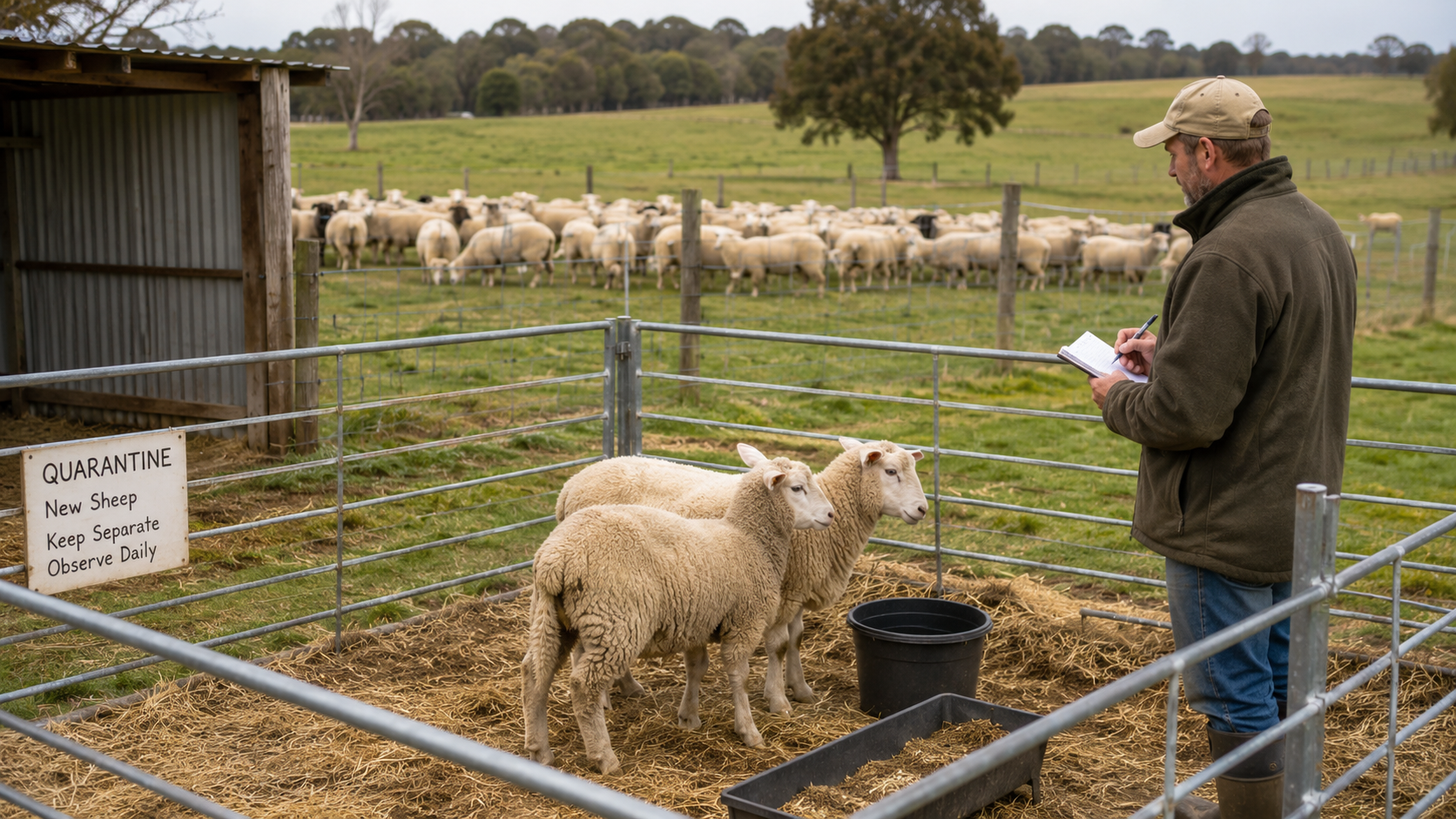
It does not have to mean a hospital building or an expensive setup. For a small flock, it may be a separate pen, a small paddock, a corner of a shed, or a temporary fenced area.
The important point is separation.
The new animal should not eat from the same feeder, drink from the same water trough, sleep in the same bedding, or touch noses with the resident flock. If possible, there should be no fence-line contact either.
The goal is simple:
Watch the new sheep before it can expose the whole flock.
Why healthy-looking sheep can still be risky
A sheep may look normal at purchase and still become a problem after arrival.
There are several reasons for this.
- The animal may be in the early stage of illness.
- Symptoms may not have appeared yet.
- Transport stress may weaken the animal.
- Parasite problems may not be visible immediately.
- Foot problems may be mild at first.
- Skin problems may be hidden by wool.
- The seller’s flock may have different disease exposure from yours.
- A ram or ewe may look strong but still carry something you do not want in your flock.
This does not mean every seller is dishonest. It means livestock movement always carries risk.
Good quarantine is not about distrust. It is about protecting the animals you already have.
How long should quarantine last?
A common practical recommendation for sheep and goats is around 30 days.
Thirty days gives the keeper time to watch the animal through the stress of transport, feed change, weather change and new surroundings. It also gives time for signs such as coughing, nasal discharge, foot problems, diarrhoea, poor appetite, skin lesions or weakness to become visible.
Some farms may use longer or shorter periods depending on disease risk, local rules, veterinary advice, pregnancy status and the flock health plan.
But the principle is the same:
Do not mix new animals immediately.
For small flocks, even a few weeks of separation can prevent a much bigger problem.
What to check every day
Quarantine only works if the animal is actually observed.
Do not just put the sheep in a separate pen and forget it. Look at the animal every day.
Check:
- appetite,
- water intake,
- manure,
- coughing,
- breathing,
- nasal discharge,
- eye discharge,
- lameness,
- feet,
- skin,
- wool,
- mouth,
- body condition,
- temperature if you are trained to take it,
- general behaviour.
A healthy sheep should be alert, eating, moving normally and settling into the new environment. A sheep that stands away, refuses feed, breathes heavily, scours, limps, coughs or looks dull should not be mixed with the flock.
If the signs are unclear, ask a veterinarian before mixing.
Do not share equipment without thinking
Many keepers separate the new sheep but then use the same buckets, ropes, boots and tools between the quarantine pen and the main flock.
That weakens the whole point of quarantine.
The new animal should have its own feed and water equipment where possible. If equipment must be shared, clean it before it returns to the main flock.
The same applies to hands, boots, trailers, hurdles and handling tools.
A simple order helps:
- Handle the main flock first.
- Handle quarantined animals after that.
- Clean boots and equipment before going back to the main flock.
This order reduces the chance of carrying problems from the new animals into the resident flock.
Where to put the quarantine pen
The best quarantine area is separate, easy to watch and easy to clean.
It should have safe fencing, clean water, dry resting space, shade or shelter, separate feed space, no direct nose-to-nose contact with the main flock, no shared bedding, no shared water source and easy access for daily checks.
It should not be a muddy corner where animals become stressed and sick. Quarantine is not punishment. It is controlled observation.
If the new animal is alone and stressed, a practical option may be to quarantine new arrivals as a small group bought together. Another option is to use a companion animal that is already part of the new arrival group, not a resident sheep from the main flock.
The exact setup depends on the farm, but the goal stays the same: reduce contact until the risk is clearer.
What to record during quarantine
A quarantine period is much more useful when simple notes are kept.
Write down:
- arrival date,
- seller or source,
- animal ID or description,
- age and sex,
- body condition,
- visible problems at arrival,
- treatments given before arrival if known,
- vaccination history if known,
- deworming history if known,
- daily observations,
- any symptoms,
- any treatments given during quarantine,
- date cleared for mixing.
These notes do not need to be complicated. Even a notebook is better than memory.
The reason is simple: when a problem appears later, the first questions are always about dates, source, symptoms and contact.
Without notes, everything becomes guesswork.
Do not use quarantine to hide a sick animal
If a new sheep becomes sick during quarantine, do not simply wait until the 30 days are over and then mix it.
The clock should not matter more than the animal’s condition.
A sick animal needs proper assessment. Depending on the signs, it may need veterinary attention, treatment, testing, longer isolation, or removal from the breeding plan.
The purpose of quarantine is not to make a risky animal acceptable by waiting.
The purpose is to find problems before they reach the flock.
Common mistakes
Mixing the animal on the same day it arrives
This is common because space is limited. But it is also the highest-risk choice.
Using only a fence between groups
Nose-to-nose contact through a fence can still spread some problems.
Sharing water and feed equipment
Separate pens lose much of their value if the same dirty buckets and tools move straight between groups.
Checking only once or twice
Quarantine requires daily observation, not just a quick look on arrival day.
Buying from many sources at once
The more sources involved, the harder it becomes to know where a problem came from.
Trusting appearance too much
A shiny coat and good body weight do not prove that an animal is safe to mix immediately.
Why quarantine is especially important for small flocks
Small flock owners sometimes think quarantine is only for large farms.
In reality, small flocks may have more to lose.
If a person owns 10 sheep and one new animal brings in a serious problem, the whole flock can be affected. There may be no spare group, no extra labour, no separate barn and no budget for a major disease event.
Small flocks also often rely on close contact. Animals share the same space, same feeder and same handling area. Once a problem enters, it can move quickly.
This is why quarantine is not a luxury.
It is a low-cost habit that protects the animals already on the farm.
A simple quarantine routine
- Before buying, ask about health history, vaccination, treatments and recent disease problems.
- Before arrival, prepare a separate pen with water, feed and shelter.
- On arrival, check the animal before unloading into the quarantine area.
- Record the arrival date and source.
- Keep the animal separate from the main flock.
- Use separate buckets and tools where possible.
- Check the animal daily.
- Watch appetite, manure, breathing, feet, skin and behaviour.
- Do not allow shared grazing, shared water or nose-to-nose contact.
- Handle the main flock first and the new sheep after.
- Call a veterinarian if suspicious signs appear.
- Mix only when the quarantine period is complete and the animal is healthy.
This routine is simple. That is why it works.
The main lesson
Buying a new sheep is easy.
Protecting the flock after the purchase takes discipline.
A quarantine pen may look like extra work, but it is cheaper than treating a whole flock, losing lambs, dealing with movement restrictions, or trying to remove a disease after it has settled in.
Thirty days may feel long.
A flock disease problem is longer.
Quarantine is not about fear. It is about giving the new animal time to show whether it is truly ready to join the flock.
Sources
- USDA APHIS, Biosecurity for Sheep and Goat Producers, last modified 24 December 2025.
- Ontario Ministry of Agriculture, Food and Rural Affairs, Biosecurity in the sheep flock, 14 July 2022.
- University of Missouri Extension, Guidelines for Implementing On-Farm Biosecurity Practices for Sheep and Goats, 21 October 2024.
- University of Wisconsin Extension, Biosecurity for bringing home new sheep and goats.
- Center for Food Security and Public Health, sheep biosecurity self-assessment materials.