

Sheep Don’t Forget a Face
Sheep remember more than many people think
Sheep are often treated as simple animals.
People say they just follow the flock, follow the feed bucket, or panic without thinking. But sheep are more observant than their reputation suggests.
One of the most interesting facts about sheep is this:
Sheep can remember faces.
Research has shown that sheep can remember many different sheep faces for long periods of time. In one well-known study, sheep were able to remember 50 different sheep faces for more than two years.
That is not a small detail. For a flock animal, face recognition is part of social life.
A sheep needs to know which animals are familiar, which animals are dominant, which animals are safe, which animals belong to the same group, and which animals are strangers. In a flock, memory is useful.
Sheep are social animals
Sheep live in groups. That means they do not only react to grass, weather and fences. They also react to other sheep.
- They notice who is nearby.
- They follow familiar animals.
- They become stressed when separated.
- They form social preferences.
- They recognize individuals.
This is one reason why a sheep can behave differently when moved alone, mixed with strangers, or separated from familiar flock mates.
To the keeper, the sheep may look nervous or stubborn.
To the sheep, the situation may be socially confusing or frightening.
They can also learn human faces
A later study from the University of Cambridge showed that sheep could be trained to recognize human faces from photographs. The sheep learned to choose familiar faces shown on a screen.
Even more interesting, the sheep were also able to identify the face of a familiar handler from a photograph without special training for that specific person.
This does not mean sheep think like humans.
It means they have stronger visual recognition ability than many people assume.
A sheep that sees you every day may learn more about you than you think.
Why this matters on the farm
This fact is not only cute. It also has practical meaning.
If sheep recognize individuals, then routine and handling style matter.
- A calm handler can become familiar.
- A rough handler can also be remembered.
- A regular routine can reduce stress.
- Sudden changes can make animals more alert.
- Quiet observation can tell you which animals trust people and which remain nervous.
For small flock owners, this is important. The same person often feeds, checks, moves and treats the sheep every day. Over time, the animals learn that person’s voice, shape, movement and behaviour.
The relationship may not look dramatic. But it exists.
The sheep that watches you is not stupid
Many keepers know this from experience.
- Some sheep come close to the same person every day.
- Some avoid a person who handled them roughly.
- Some recognize the feed routine before the bucket appears.
- Some calm down faster when a familiar person enters the pen.
- Some mothers are more relaxed when the usual keeper is nearby.
Science does not make these observations less real. It helps explain them.
Sheep are not machines. They are animals with memory, social awareness and individual behaviour.
A better way to look at the flock
When you stand in front of a group of sheep, they are not all reacting in the same way.
One ewe may be curious. Another may be cautious. A lamb may copy its mother. An older sheep may recognize the person at the gate. A nervous animal may remember a previous bad experience.
This is why good handling is not only about strength or speed.
It is about consistency.
- Move calmly.
- Use the same routines.
- Avoid shouting when possible.
- Do not rush animals into panic.
- Pay attention to which sheep are nervous, bold, weak, isolated or unusually quiet.
A flock that trusts the handler is easier to move, check and treat.
The main lesson
Sheep remember more than many people think.
They can recognize faces. They can learn familiar individuals. They can notice patterns. They can respond differently to people, animals and situations they know.
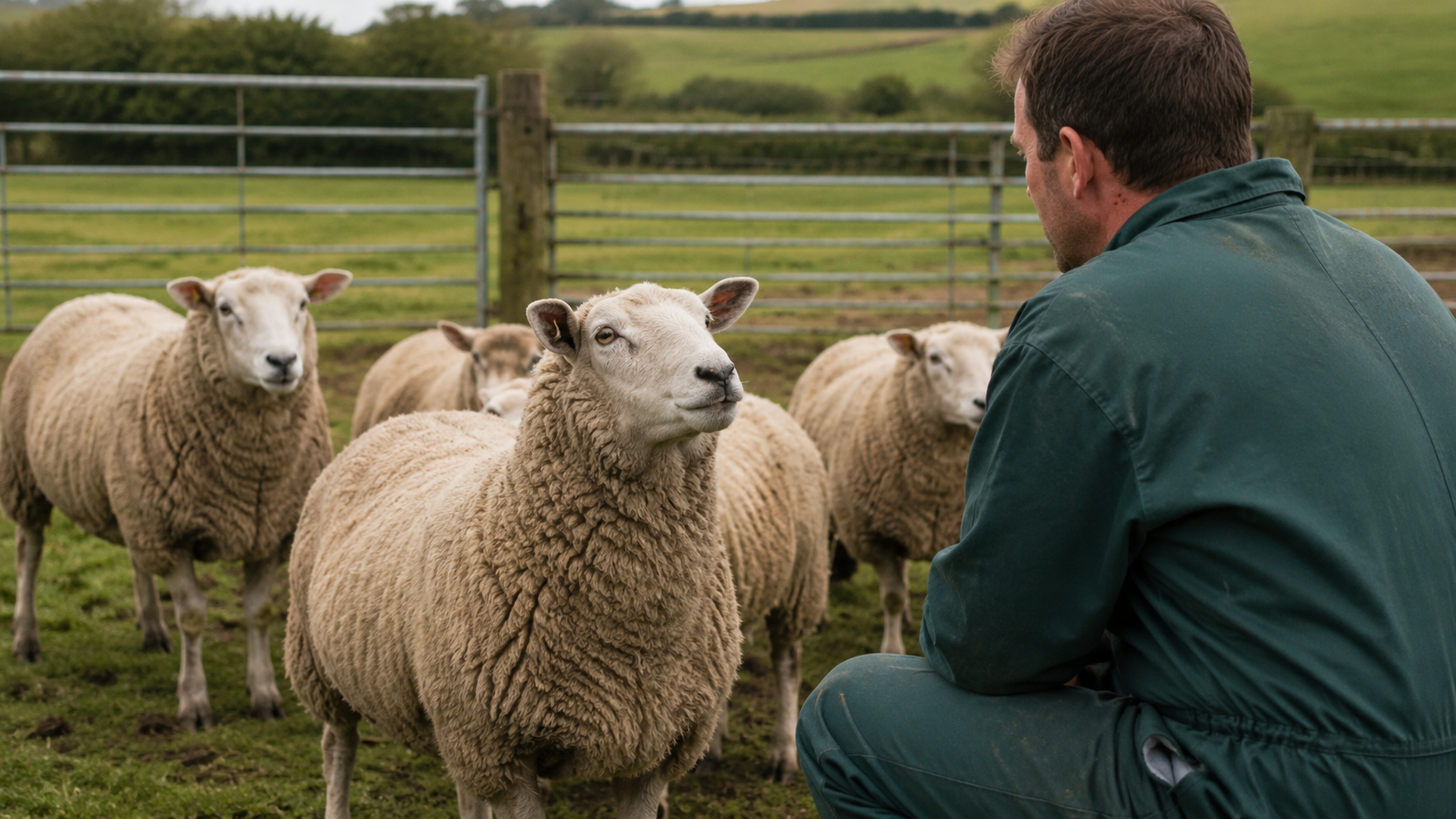
So when a sheep looks at you as if it knows who you are, it probably does.
They are not just following feed.
They are watching, learning and remembering.
Sources
- Kendrick et al., “Sheep don’t forget a face,” Nature, 2001.
- University of Cambridge, “Sheep are able to recognise human faces from photographs,” 8 November 2017.
- Knolle, Goncalves and Morton, “Sheep recognize familiar and unfamiliar human faces from two-dimensional images,” Royal Society Open Science, 2017.