

CONDITION SCORING
Body Condition Scoring Sheep Without a Scale
A practical hands-on guide to checking sheep body condition without a scale.
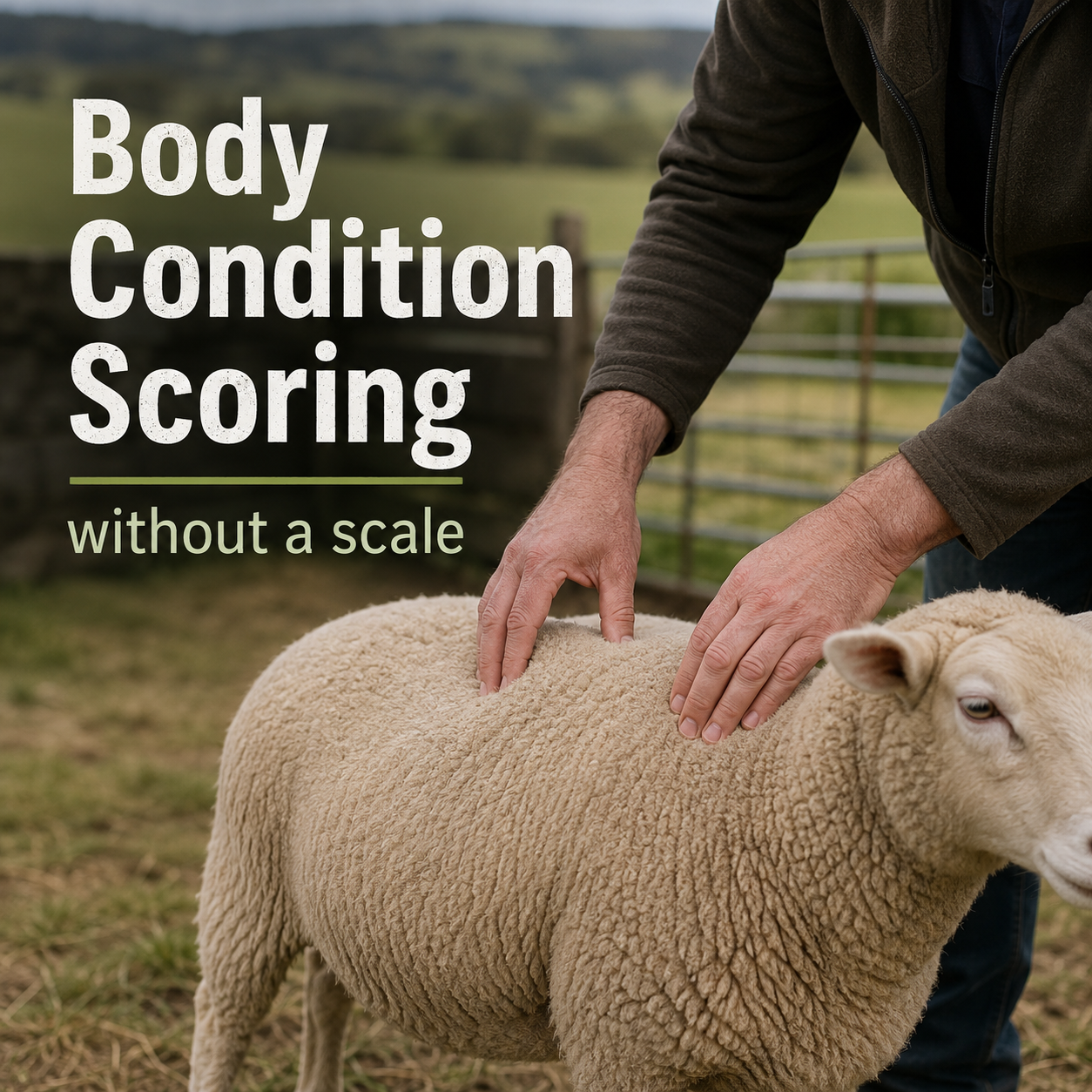
A practical hands-on guide to checking sheep body condition without a scale.
A sheep can look fine from a distance and still be too thin under the wool.
That is why body condition scoring is one of the most useful hands-on checks in sheep farming. It does not require a scale, a device or a special setup. It requires your hand, a consistent method and a few minutes of attention.
Body condition scoring is not the same as weighing. Weight tells you how heavy the animal is. Body condition tells you how much fat and muscle cover the animal is carrying. A large-framed sheep can still be too thin. A woolly sheep can look better than it really is. A smaller animal can sometimes be in better working condition than a bigger one.
The most important rule is simple: do not score sheep only by looking at them.
Wool hides a lot.
The main area to check is the loin, behind the last rib and before the hip. This is where you feel the backbone and the short ribs. Extension guides describe sheep body condition scoring as a hands-on assessment of fat and muscle cover around the vertebrae in the loin region. (OSU Extension Service)
Place your hand over the top of the loin.
Feel the spine.
Then move your fingers slightly to each side and feel the short ribs.
You are checking how sharp or covered those bones feel. You are not trying to press hard or hurt the animal. You are simply feeling whether the bones are prominent, lightly covered, well covered or difficult to feel.
Most sheep body condition scoring systems use a 1 to 5 scale.
Score 1 — Very thin
The spine feels sharp. The short ribs are easy to feel. There is very little cover over the bones. This animal needs attention.
Score 2 — Thin
The bones are still easy to feel, but there is some cover. The animal is not extremely thin, but it is below ideal working condition for many production stages.
Score 3 — Good working condition
The spine and short ribs can be felt, but they are not sharp. There is reasonable muscle and fat cover. For many adult sheep, this is a useful middle condition.
Score 4 — Fat
The bones are harder to feel. The loin is well covered. This may be acceptable in some situations, but it can become a problem if the animal keeps gaining condition.
Score 5 — Very fat
The bones are very difficult to feel. The animal has heavy fat cover. This is not simply “strong condition”; it can create its own management risks.
The exact ideal score depends on breed, age, production stage, weather, feed quality and farm system. A ewe before lambing, a dry ewe, a growing lamb and a ram before breeding do not all need the same condition. But extremes are rarely good.
Body condition affects real farm outcomes.
A thin ewe may struggle before lambing. She may have less reserve for milk production. She may be pushed back at the feeder. She may look normal until the pressure of late pregnancy or early lactation exposes the problem.
An over-fat sheep can also cause trouble. Fat animals are not automatically productive animals. Over-conditioning can increase risk around breeding, movement, heat stress and lambing.
This is why body condition scoring is useful before problems become visible.
It helps you ask better questions:
Is this animal thin because she is old?
Is she losing condition because of teeth?
Is the group feed not enough?
Is one animal being bullied away from the feeder?
Is the ration good on paper but not working in the pen?
Is this ewe going into lambing with enough reserve?
A scale can help, but it will not answer these questions alone.
Useful moments include:
Before breeding.
During pregnancy.
Before lambing.
After weaning.
When buying sheep.
When selling breeding animals.
When changing feed.
When a sheep looks dull, slow or separated from the group.
You do not need to score the whole flock every day. But checking a few animals from each group regularly can show where the flock is going.
Do not only check the best-looking sheep near the front.
Handle quiet animals, older ewes, thin lambs, late lambers and animals that stand away from the group.
The average of the flock can hide individual problems.
Pick the same scoring method and use it consistently.
If two people on the farm score animals, they should compare a few sheep together first. One person’s “3” should not be another person’s “2”. The score does not need to be perfect, but it needs to be consistent enough to guide decisions.
The value is not only in the number.
The value is in noticing change.
A ewe moving from 3 to 2 matters.
A lamb that stays thin while others improve matters.
A ram losing condition before breeding matters.
A group that looks full of wool but scores poorly matters.
Body condition scoring is simple, cheap and practical.
It helps you see what wool can hide.
It helps you separate body size from real condition.
And it helps you act before a small problem becomes an expensive one.
Your eyes are useful.
But your hand tells the truth.