

FARM COSTS
The Hidden Cost of Keeping Weak Animals Too Long
Why keeping weak animals too long can quietly drain feed, time, space and profit from a sheep farm.
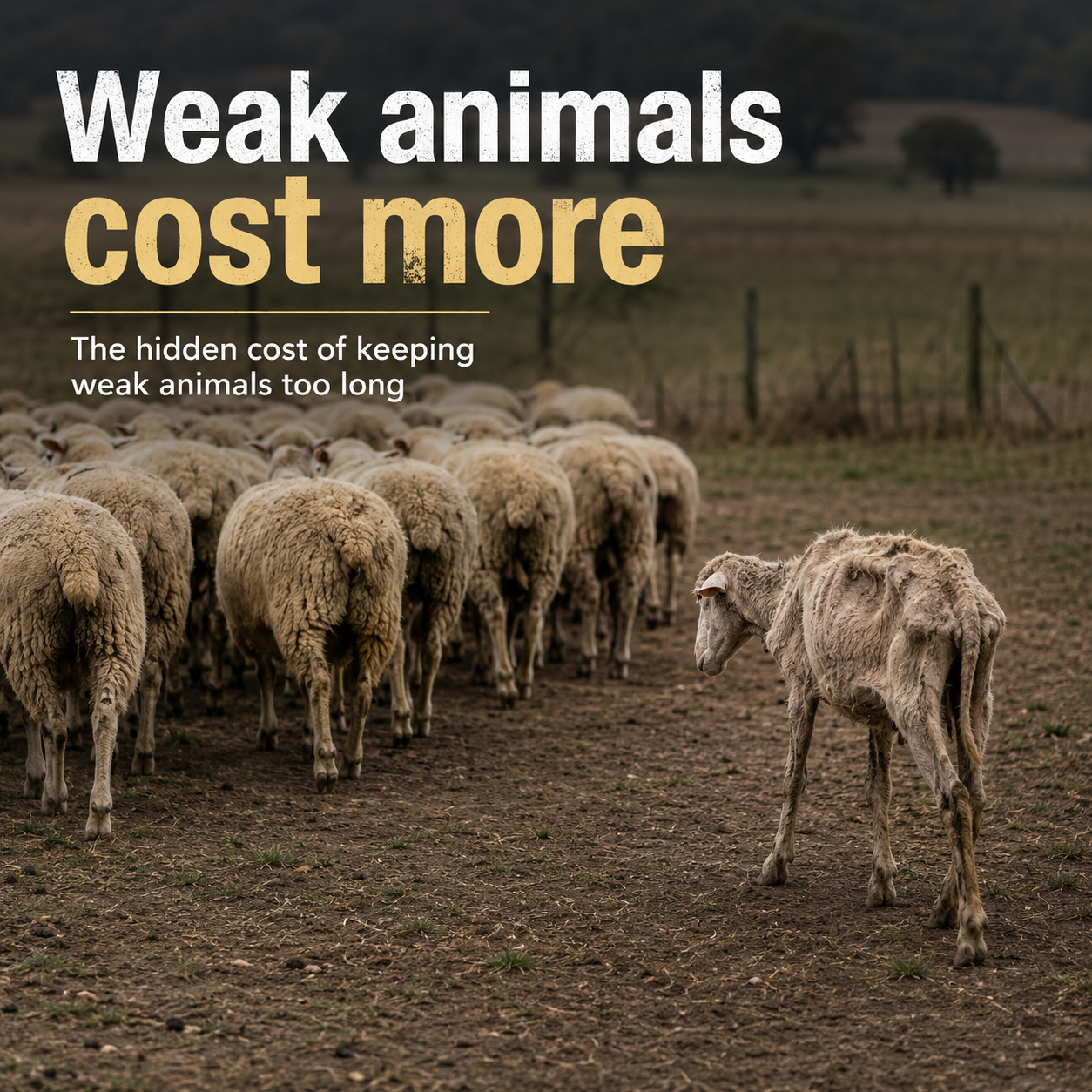
Why keeping weak animals too long can quietly drain feed, time, space and profit from a sheep farm.
Every sheep farmer knows the obvious costs.
Feed.
Medicine.
Bedding.
Labour.
Transport.
Replacement animals.
But one of the most expensive costs on a sheep farm is often less visible: keeping weak animals too long.
Not every weak animal should be removed immediately. Some animals recover. Some deserve treatment. Some problems are temporary. Good farmers do not give up on animals just because they need care.
But there is a difference between helping an animal recover and carrying an animal that keeps draining the farm.
That difference matters.
Every flock has animals that quietly take more than they return.
The ewe that loses condition every season.
The lamb that never catches up.
The sheep that repeatedly goes lame.
The animal that eats but does not grow.
The ewe that needs help every lambing.
The one that gets sick first when the weather changes.
The one that always needs extra attention while the rest of the group moves forward.
One weak animal may not look like a business problem.
But over time, it becomes one.
It takes feed.
It takes space.
It takes treatment.
It takes time.
It distracts the farmer from animals that could perform better with the same resources.
Feed is expensive because it is constant.
A weak animal eats from the same farm budget as a productive one.
If that animal does not gain weight, raise lambs, recover condition or contribute to the flock, the feed cost does not disappear. It simply becomes harder to justify.
This is especially important in meat lamb systems.
A lamb that grows slowly is not only “a small lamb.”
It is a lamb that stays on feed longer.
It uses pen space longer.
It delays sale.
It increases labour per kilogram produced.
It may force the farmer to manage different sizes in the same group.
The cost is not only the feed eaten today.
The cost is the extra days.
One weak sheep can affect the whole group.
If the farmer keeps changing feed for the weakest animals, stronger animals may become overfed.
If the farmer holds the whole group back because a few lambs are not ready, the better lambs lose marketing timing.
If a ewe needs individual care every season, she changes the labour rhythm of the farm.
If a chronically lame animal remains in the group, foot problems may keep returning.
The weak animal is not always isolated as a single problem.
Sometimes it changes decisions for everyone.
There is also an emotional side.
Farmers often keep weak animals because they remember the effort already spent on them.
A lamb was bottle-fed.
A ewe was treated several times.
A sheep survived a hard period.
The farmer feels that removing it now would waste all that work.
But this is a trap.
Past effort is already spent.
The real question is what the animal will cost from today forward.
Will it recover and perform?
Or will it continue to need feed, treatment and attention without becoming productive?
Good stockmanship includes care.
But it also includes hard decisions.
Keeping a weak animal can make sense when the problem is clear, temporary and recoverable.
For example:
A lamb recovering from a short illness.
A ewe that lost condition because of a specific feed shortage.
An animal injured in a way that is healing well.
A valuable breeding animal with a one-time problem.
A young animal that was set back but is now improving steadily.
The key word is improving.
If the animal is moving in the right direction, keeping it may be reasonable.
Keeping becomes expensive when the same animal repeatedly fails.
Repeated lameness.
Repeated poor body condition.
Repeated lambing trouble.
Repeated treatment.
Poor growth with no clear improvement.
Poor mothering.
Bad teeth in an animal expected to stay productive.
Any animal can have one bad season.
But when the same animal creates the same problem again and again, the farm is no longer solving a problem. It is maintaining a loss.
A useful question is not:
“Do I like this animal?”
The useful question is:
“Would I choose to buy this animal today?”
If the honest answer is no, keeping it needs a reason.
Another useful question:
“Is this animal improving, or am I just hoping?”
Hope is not a management plan.
The hidden cost of weak animals is not just money.
It is attention.
It is pen space.
It is feed.
It is stress.
It is missed timing.
It is the better animal that did not get the resources.
It is the group that had to be managed around the weakest member.
A sheep farm does not become stronger by keeping every animal forever.
It becomes stronger by knowing which animals deserve another chance and which animals are quietly holding the flock back.
Care for animals.
Treat what can be treated.
But do not confuse kindness with keeping every loss in the flock.
Sometimes the most profitable decision is also the cleanest management decision: stop carrying animals that never recover.