

DRENCHING SAFELY
How to Put a Drench Gun in the Mouth Without Hurting the Sheep
A practical guide to placing a drench gun safely in a sheep’s mouth without rushing or hurting the animal.
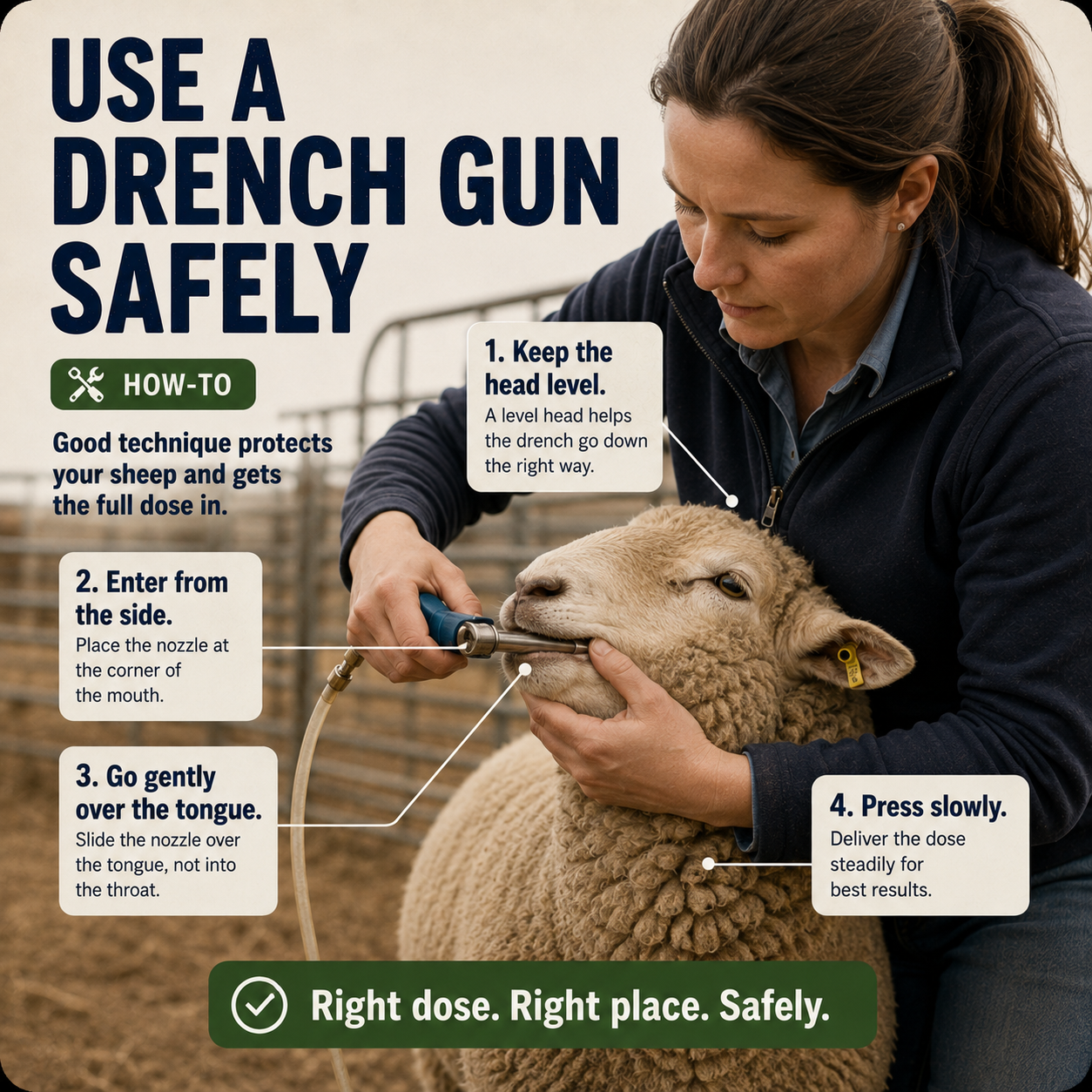
A practical guide to placing a drench gun safely in a sheep’s mouth without rushing or hurting the animal.
Drenching looks simple from the outside.
Hold the sheep, put the gun in, press the trigger, move to the next animal.
But the small details matter.
A drench gun is not just a dosing tool. It is going into the animal’s mouth. If the angle, speed or position is wrong, the sheep may spit out the product, receive a partial dose, injure its mouth, or take liquid where it should not go.
The goal is not to be fast.
The goal is to get the right dose swallowed safely.
Before drenching, check three things.
First, read the product label. Dose, withholding period, export slaughter interval and warnings matter.
Second, set the dose for the correct animal weight. If the mob has a wide weight range, draft lighter and heavier animals separately.
Third, check the gun. A rough barrel can cut the mouth. A leaking gun can underdose. A badly calibrated gun can create a whole-mob mistake.
MLA recommends calibrating the drench gun with a measuring cylinder before starting, and checking again after every 200 sheep. (MLA)
This is one of the most important details.
Do not point the sheep’s nose straight up.
Hold one hand under the chin and keep the head level. A level head helps the sheep swallow normally and reduces the chance of drench going the wrong way.
MLA specifically recommends holding the head horizontal while slipping the gun into the side of the mouth. (MLA)
The drench gun should enter from the side of the mouth, between the front teeth and the molars.
Do not ram it in.
Insert it gently. A slight twist can help the barrel enter without scraping or forcing. Then slide the barrel backwards over the tongue until the tip rests on the back of the tongue.
That position matters because the animal has to swallow the drench, not fight it.
Once the gun is in the right place, press the plunger slowly and steadily.
Do not blast the dose into the mouth.
After the dose is given, keep one hand under the sheep’s chin for a short moment so it does not immediately spit the drench out.
For large-volume drenches, the animal may need more time. MLA advises stopping briefly after each 10 ml to check that the sheep is swallowing. (MLA)
Watch the sheep for a moment before moving on.
Coughing, spluttering, liquid dripping from the nose, trembling, unsteadiness or abnormal behaviour are not things to ignore.
MLA notes that coughing or drench from the nose can mean the product was not swallowed correctly and may have gone into the windpipe. (MLA)
If something looks wrong, stop. Check the technique, the product, the dose and the animal. Call a veterinarian when needed.
Do not turn drenching into a race.
A fast operator may look efficient, but a sheep that spits out the dose has not been treated properly. A sheep injured by poor technique may cost far more than the seconds saved.
Good drenching is calm, controlled and repeatable.
Hold the head level.
Enter from the side.
Place the barrel over the tongue.
Press slowly.
Make sure the sheep swallows.
That is the job.