

FLOCK BEHAVIOUR
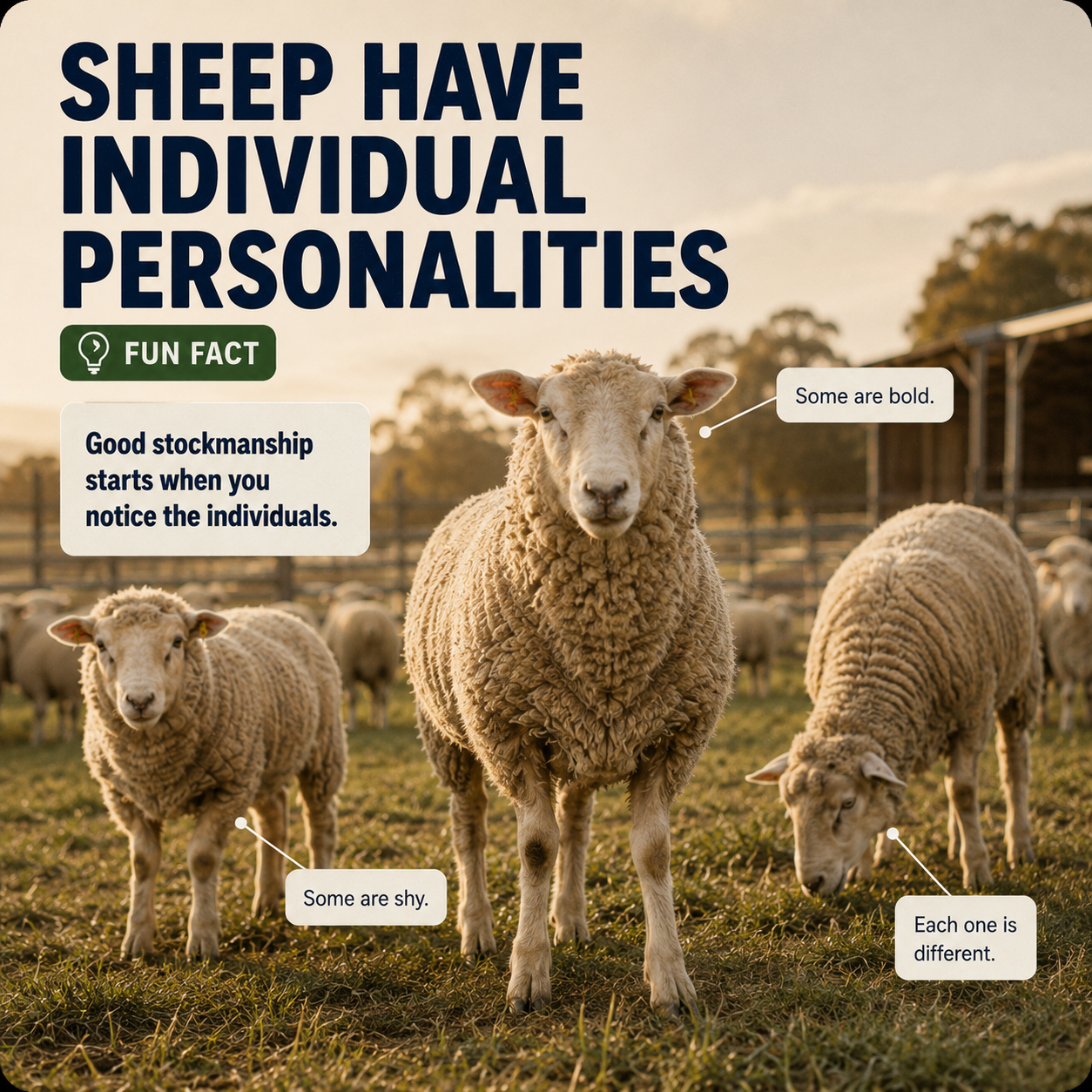
Sheep Have Individual Personalities
A practical article on individual differences in sheep behaviour and why they matter in daily flock work.
A practical article on individual differences in sheep behaviour and why they matter in daily flock work.
From a distance, a flock can look like one moving animal.
It turns together. It runs together. It gathers together. It follows pressure together.
But anyone who spends time with sheep knows the truth.
The flock is made of individuals.
One ewe is always first to the trough. One lamb hangs back at the gate. One animal learns a routine quickly. One panics at small changes. One avoids contact. One pushes others away. One stands quietly but watches everything.
These differences matter.
Animal behaviour researchers use words like temperament, personality, coping style and behavioural profile to describe consistent differences between individuals.
In sheep, studies have looked at social behaviour, stress response, movement, vocalisation and group behaviour.
One study on social personality in sheep identified personality profiles such as avoider, affiliative, aggressive and pragmatic, based on social behaviour and success inside the flock. (ResearchGate)
Another study on sheep temperament notes that vocalisations and locomotory behaviours are often repeatable over time when sheep are tested individually, although behaviour inside a social group can be different. (PMC)
That last point is important for farmers.
A sheep is not only “bold” or “shy” in a fixed way.
Its behaviour can also change depending on the group, the pen, the handler, the season, feed pressure and stress.
Personality is not just interesting.
It affects work.
The first sheep through a gate can teach the rest to move. The nervous sheep can make a calm group harder to handle. The pushy feeder can hide a competition problem. The shy animal may lose condition without drawing attention. The smart escape artist may find the weak part of the fence before you do.
If you manage only the average, these individuals disappear.
But farms do not lose money only through average problems.
They lose money through specific animals, specific habits and specific patterns.
Sheep are social animals with strong flocking behaviour. MSD Veterinary Manual notes that sheep generally remain in social groups and synchronise behaviour with other sheep in the flock. (MSD Veterinary Manual)
That flock behaviour is useful.
It makes handling possible. It gives sheep safety. It lets a shepherd move many animals at once.
But it can also hide problems.
A weak animal may move with the group just long enough to look normal. A bullied animal may eat only after the stronger sheep finish. A nervous animal may create trouble only at the race, not in the field. A quiet animal may be easy to overlook.
The flock shows one story.
The individual sheep may show another.
Do not try to turn sheep into pets.
That is not the point.
The point is to notice repeatable patterns.
Which sheep always comes first? Which one always hangs back? Which one avoids the feeder? Which one needs slower handling? Which one causes trouble at the gate? Which one changes behaviour suddenly?
Good shepherding is not only knowing sheep in general.
It is knowing this sheep, in this flock, under these conditions.
A flock may move as one.
But it never thinks, reacts or performs as one.