

FUN FACT
Sheep Have Rectangular Pupils for a Reason
A practical fun fact article explaining why sheep have rectangular pupils and what it means for handling and flock movement.
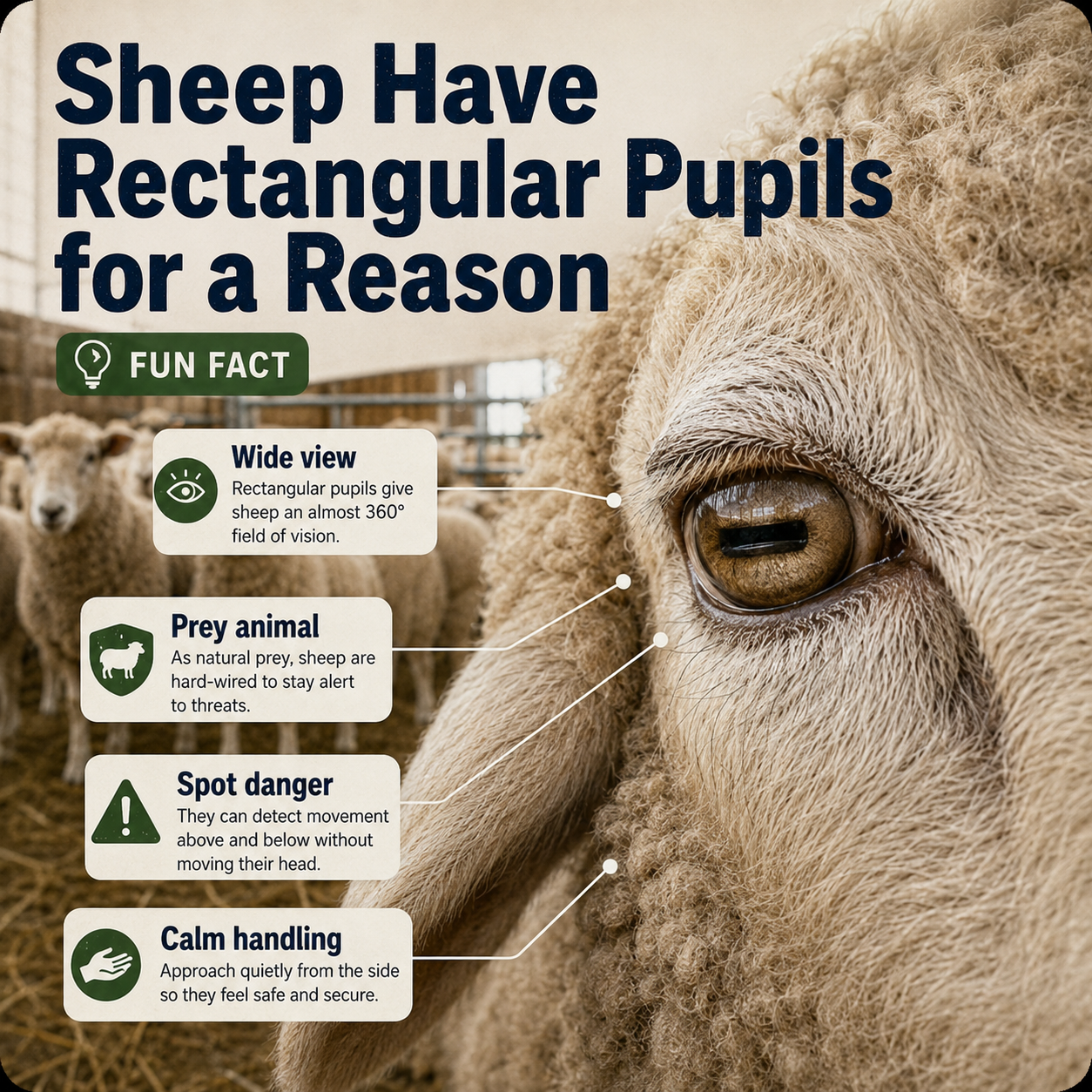
A practical fun fact article explaining why sheep have rectangular pupils and what it means for handling and flock movement.
Look closely at a sheep’s eyes and you will see something unusual.
The pupils are not round like ours. They are horizontal and rectangular. This is not a strange detail. It is part of how sheep survive as prey animals.
In simple terms, sheep are built to watch the world differently from humans.
Humans have forward-facing eyes. We are good at focusing in front of us.
Sheep have eyes on the sides of their heads. This gives them a much wider view of their surroundings. For a prey animal, that matters. Danger can come from the side or behind, not only from the front.
The horizontal pupil helps support that wide field of view.
This is why sudden movement near sheep can affect the whole flock. One animal notices something, reacts, and the rest respond quickly.
Sheep are not designed to stand and fight. They are designed to notice danger early and move with the group.
That explains many behaviours farmers see every day: they react strongly to sudden movement, dislike being approached directly and quickly, may bunch together when unsure, and often move better when pressure is calm and predictable.
The rectangular pupil is part of that whole system.
This is not just a fun fact. It has practical value.
If sheep see wide and react as prey animals, then handling should respect that.
Move slowly. Avoid sudden arm movements. Do not shout unless absolutely necessary. Give sheep a clear exit direction. Avoid trapping them visually with confusing pressure. Use calm body position instead of force.
A sheep that “panics for no reason” may simply be reacting to something it saw from an angle you did not notice.
Because sheep are highly aware of movement around them, one nervous animal can influence the group. When handling or observing, watch the whole flock.
Are heads turning in one direction? Is the group freezing? Is one animal alerting the others? Are they bunching near a corner? Are they avoiding a gate because of a shadow, object, dog, or person?
Sometimes the problem is not stubborn sheep. Sometimes the problem is what the sheep can see.
Rectangular pupils are not just a curiosity.
They are a reminder that sheep experience the farm differently from us. They see wider, react earlier, and depend on group movement for safety.
Better handling starts when we stop asking, “Why won’t they move?” and start asking, “What are they seeing?”