The Bowline Knot for Sheep: How to Tie a Non-Tightening Loop Safely
A practical guide for sheep keepers
Tying a sheep looks simple, but it can become dangerous very quickly if the wrong knot is used.
Sheep are strong, reactive animals. Even a calm sheep may suddenly pull back, twist, jump, or panic when restrained. If the rope is tied with a sliding knot, the loop can tighten each time the animal pulls. That can put pressure on the neck, restrict breathing, increase panic, and create a serious welfare risk.
This is why one of the most useful knots for sheep keepers is the bowline knot.
The bowline is a classic knot used to create a fixed loop at the end of a rope. When tied correctly, the loop does not tighten under load. This is the reason it is widely used in sailing, outdoor work, livestock handling, and many situations where a secure but non-sliding loop is needed.
In sheep handling, this matters because the goal is not just to hold the animal. The goal is to hold the animal without creating a choking loop.
But there is a very important point:
A bowline is safer than a sliding knot, but it does not make tying completely safe by itself.
The knot is only one part of safe handling. Rope type, loop size, tying point, rope length, animal temperament, and supervision all matter.
What is a bowline knot?
A bowline knot forms a fixed loop at the end of a rope. The loop stays the same size when pressure is applied.
This makes it different from a slip knot or a noose-type loop. A sliding loop can tighten when the animal pulls. A bowline should not.
For sheep, this can be useful during short, controlled tasks such as vaccination preparation, foot inspection, temporary restraint, moving an animal into position, connecting a rope to a halter, or creating a non-tightening loop at the end of a handling rope.
The safest use is usually not directly around the sheep’s neck, but attached to a proper halter or suitable handling point.
If a loop must be used near the neck, it should be for short-term controlled handling only, with the animal watched at all times.
Why sliding knots are dangerous
A sliding knot may look harmless when it is loose. The problem starts when the sheep pulls.
A sheep may pull back because it is frightened, separated from the flock, handled by unfamiliar people, or placed in a new environment. With a sliding knot, the loop may shrink as the rope tightens.
This can cause pressure on the neck, breathing difficulty, panic and stronger pulling, skin irritation or rope burn, injury around the jaw, ears, or throat, falling, twisting, or dangerous entanglement.
The basic rule is simple:
Never use a knot that tightens around the animal as it pulls.
A correctly tied bowline avoids that specific problem because the loop remains fixed.
How to tie a bowline knot
Before using this knot around any animal, practice it several times with an empty rope.
Do not learn the knot for the first time on a sheep. Tie it, untie it, pull it, test it, and make sure you understand which part moves and which part stays fixed.
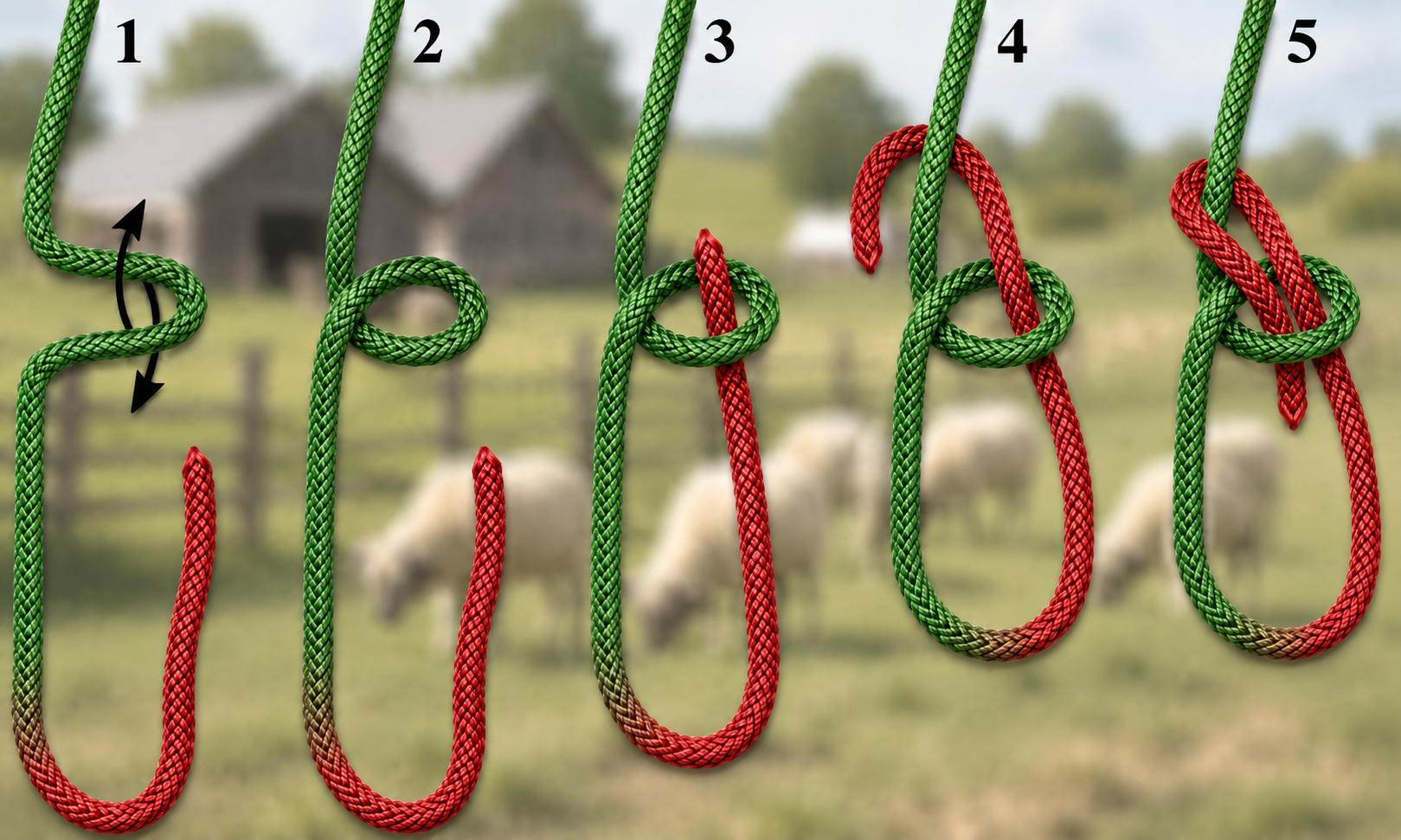
Step 1: Make a small loop
Hold the rope and make a small loop near the end. This small loop is the “hole” in the common memory phrase.
You should have two parts of rope: the standing part, which is the long main part of the rope, and the free end, which is the short end you use to tie the knot.
Step 2: Pass the free end through the loop
Take the free end and pass it up through the small loop.
This is often remembered as: the rabbit comes out of the hole.
Step 3: Go around the standing part
Now take the free end around the standing part of the rope.
This is the “tree” in the memory phrase: the rabbit goes around the tree.
Step 4: Pass the free end back through the loop
After going around the standing part, pass the free end back down through the original small loop.
This completes the phrase: the rabbit goes back into the hole.
Step 5: Tighten and test
Pull the standing part and the large loop to tighten the knot. The knot should sit firmly, and the large loop should stay fixed.
Now test it. Pull on the standing part. Pull on the loop. Check whether the loop becomes smaller.
If the loop slides smaller, it is not a correct bowline or it has been tied incorrectly.
Easy memory phrase
The classic memory phrase is:
The rabbit comes out of the hole, goes around the tree, and goes back into the hole.
In this phrase, the hole is the small loop, the tree is the standing part of the rope, and the rabbit is the free end of the rope.
This simple image helps beginners remember the direction of the knot.
How to use it with sheep
The best practice is to use a proper sheep halter whenever possible.
A bowline can then be used to create a fixed loop or connection point on the rope. This is much safer than placing a sliding loop directly around the animal’s neck.
Before tying the sheep, check these points:
- The loop must not tighten.
- The rope must not be too thin or sharp.
- The sheep must be able to hold its head normally.
- The rope must not catch under the jaw, around the ears, or inside the mouth.
- The animal must not be able to step over the rope.
- The rope must not be so long that it wraps around the legs.
- The tying point must be strong, smooth, and safe.
- The animal must remain under supervision.
A tied sheep should always be watched, especially during the first few seconds. That is when panic pulling usually happens.
If the sheep pulls hard, twists, falls, or tries to jump over the rope, release or adjust the setup immediately.
Choosing the right rope
Even a good knot can become unsafe with the wrong rope.
Avoid very thin nylon cord, baling twine, wire, plastic strip, or anything that can cut into the skin. A sheep can pull with surprising force, and a thin rope can create concentrated pressure.
A safer rope should be thick enough not to cut, soft enough not to burn or scrape, strong enough not to snap, easy to grip, easy to untie, and suitable for livestock handling.
The rope should hold the animal without acting like a cutting line.
The tying point matters too
The knot on the animal side is only half of the setup. The other end of the rope also matters.
Do not tie a sheep to sharp metal, broken fencing, loose gates, barbed wire, unstable posts, or anything the animal can drag away.
The tying point should be solid, smooth, and positioned so the rope does not trap the animal.
The rope length should also be controlled. Too short, and the sheep may panic or be forced into an unnatural position. Too long, and the sheep may step over the rope, wrap it around its legs, or turn itself into a dangerous tangle.
The goal is:
Controlled movement, not a rope trap.
Common mistakes
Mistake 1: Confusing a slip knot with a bowline
Some knots look similar at first glance. The real test is whether the loop tightens under pressure. Always pull and test the knot before using it.
Mistake 2: Leaving the free end too short
After tying the bowline, leave enough tail on the free end. If the tail is too short, the knot may become less secure.
Mistake 3: Using thin or harsh rope
A non-tightening loop can still cause injury if the rope is too thin, rough, or sharp.
Mistake 4: Leaving the sheep unattended
A bowline reduces the tightening risk, but the sheep can still fall, twist, panic, or get tangled. Never leave a tied sheep alone.
Mistake 5: Making the loop too tight
A fixed loop does not shrink, but it can still be too small from the beginning. The loop should not press tightly into the neck or restrict normal posture.
Mistake 6: Giving too much rope
Long rope can wrap around legs or objects. This is one of the most common causes of accidents with tied animals.
When not to tie a sheep
Do not tie a sheep if the animal is panicking heavily, the area is unsafe, the rope is unsuitable, the sheep will be left alone, there is barbed wire or sharp material nearby, the sheep is weak, sick, heavily pregnant, or injured, the rope may wrap around the legs, or you cannot release the animal quickly in an emergency.
In these situations, use a safer method: a small pen, a handling race, a proper halter, or another person helping you hold the animal calmly.
Final point
The bowline knot is one of the most useful knots a sheep keeper can learn.
It creates a fixed loop that does not tighten when the animal pulls. That makes it much safer than a sliding loop for short, supervised handling.
But the knot alone is not enough.
Safe sheep handling also requires the right rope, the right tying point, the right rope length, a calm approach, and constant supervision.
A good knot should control the sheep without choking it.
A good handler should always be ready to adjust, release, or stop if the animal is at risk.