

PPR in Europe: New EU Emergency Measures for Romania and Croatia
What sheep keepers should take from the June 2026 EU updates
On 18 June 2026, the European Union published new emergency measures related to peste des petits ruminants virus, also known as PPR, in Romania and Croatia.
The Romanian update was published as Commission Implementing Decision (EU) 2026/1387, dated 17 June 2026. The Croatian update was published as Commission Implementing Decision (EU) 2026/1389, also dated 17 June 2026. Both were published in the Official Journal on 18 June 2026.
Both decisions concern small ruminants: sheep and goats.
News source: European Union / EUR-Lex.
Romania: Commission Implementing Decision (EU) 2026/1387 of 17 June 2026, published 18 June 2026.
Croatia: Commission Implementing Decision (EU) 2026/1389 of 17 June 2026, published 18 June 2026.
For small sheep keepers, this is not just a legal update. It is a reminder that animal movement, new purchases, shared equipment and delayed reporting can turn a local disease problem into a much wider one.
What happened?
The EU decision for Romania amended existing emergency measures for infection with PPR virus. The decision followed a notification from Romania on 8 June 2026 of one outbreak in an establishment keeping susceptible animals.
The EU decision for Croatia introduced interim emergency measures after Croatia reported three outbreaks on 11 and 12 June 2026 in establishments keeping sheep and goats in Bjelovarska-Bilogorska County.
The Croatian decision also states that movements of sheep and goats from the territory of Croatia to destinations outside Croatia are prohibited until 30 September 2026.
These are not ordinary farm notices. They are EU-level animal health measures.
What is PPR?
PPR stands for peste des petits ruminants. It is a contagious viral disease that affects small ruminants, mainly sheep and goats.
The disease can have a serious effect on animal health, flock profitability, animal movements, trade and exports. When an outbreak is confirmed, authorities may create restricted zones, protection zones, surveillance zones, movement controls and other emergency measures.
For the farmer, the disease may appear first as a health problem in the flock. For the wider sector, it quickly becomes a movement and trade problem.
That is why PPR is taken seriously.
Why this matters to sheep keepers
Disease does not spread only through visibly sick animals.
It can move through ordinary livestock work: buying animals, selling animals, borrowing a ram, sharing a trailer, moving sheep to another grazing area, visiting another flock, using shared handling equipment, taking animals to markets, mixing animals before isolation or waiting too long before reporting suspicious signs.
Small farms are not outside this risk.
In many small flocks, animals are handled by family members, neighbours, local traders or shared service providers. A trailer may visit several farms. Equipment may move from one pen to another. A new animal may be placed straight into the flock because there is no spare pen.
That is exactly why simple prevention habits matter.
Watch animal movement first
During any disease alert, animal movement should be treated carefully.
Do not move sheep or goats casually between farms, grazing areas, markets, neighbours or temporary pens. Before moving animals, check local rules and official restrictions.
If animals have recently come from an affected region, do not mix them directly with the main flock.
Movement control is not only a government rule. It is also a practical farm habit.
A disease that stays in one place is easier to control. A disease that moves with animals becomes much harder to stop.
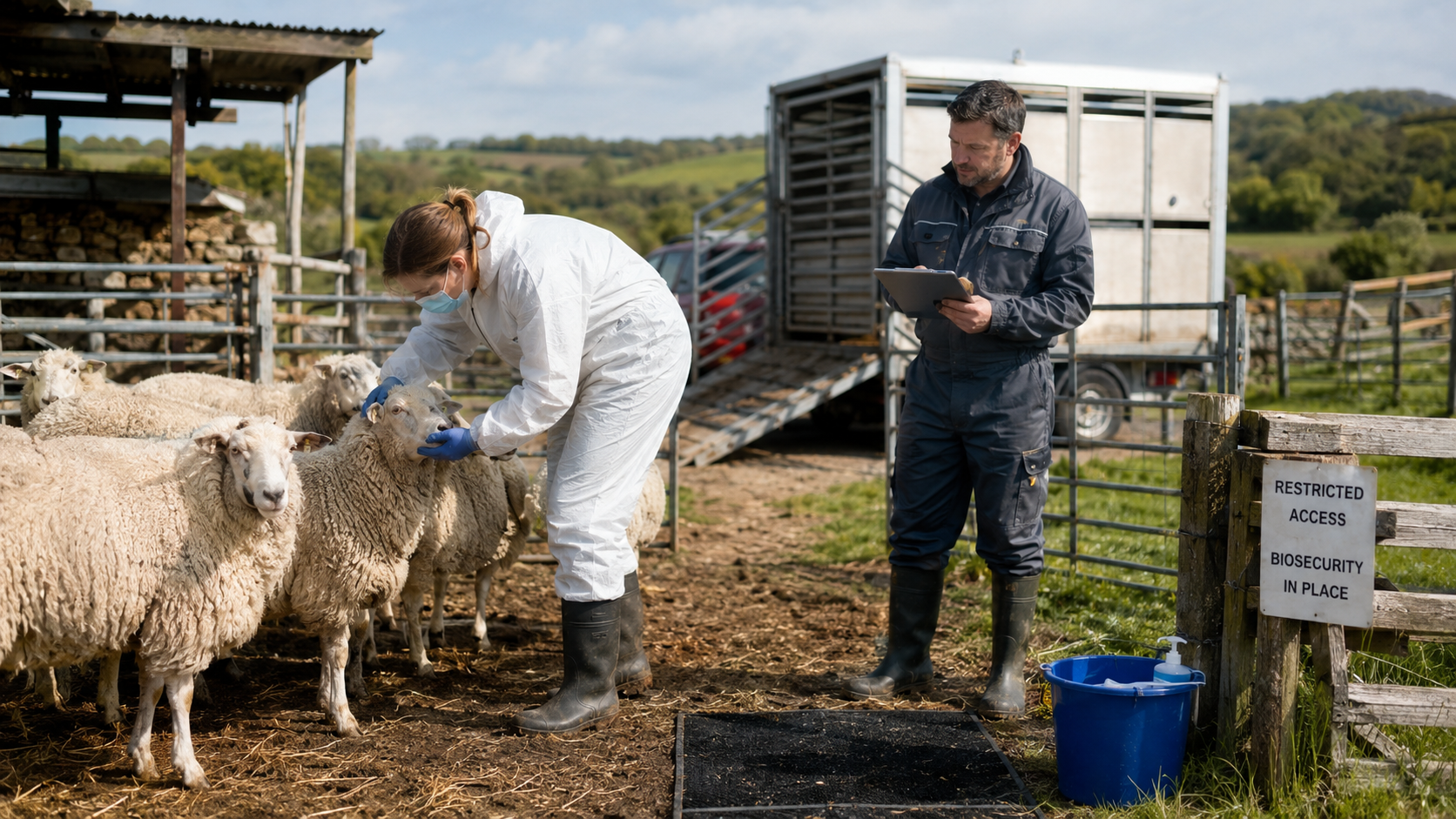
Isolate new animals
One of the most important steps for any sheep keeper is simple:
New animals should not go straight into the flock.
Even if the seller is trusted, even if the animal looks healthy, and even if the flock is small, isolation is still useful.
A new sheep or goat should be kept separate long enough to observe appetite, temperature if possible, nasal or eye discharge, coughing or breathing signs, mouth lesions, diarrhoea, weakness, sudden weight loss, unusual behaviour, abortions or reproductive problems.
The isolation area does not need to be perfect. But it should reduce direct contact with the main flock.
Separate feed and water equipment is better. If the same person handles both groups, the healthy resident flock should be handled first, and the new or suspicious animals after that.
Clean shared equipment
Shared equipment is common in livestock areas.
Trailers, hurdles, ropes, buckets, gates, weighing crates, shearing equipment and boots can all move between farms. If they are not cleaned, they may carry dirt, manure, bedding, secretions or other contamination.
During disease alerts, shared equipment should be treated as a risk.
Before equipment moves from one farm to another, remove visible dirt and organic material. Clean and disinfect where possible. Do not allow a trailer that has just carried unknown animals to enter a clean flock area without attention.
This is not about fear. It is about not bringing another flock’s problem into your own yard.
Know the warning signs
Farmers should not try to diagnose PPR on their own. Suspicious signs should be reported to a veterinarian or local animal health authority.
But sheep keepers should know which signs deserve attention.
Possible warning signs may include fever, weakness, loss of appetite, nasal discharge, eye discharge, mouth lesions, breathing difficulty, coughing, diarrhoea, sudden deaths, abortions or rapid spread of illness in a group.
Not every sick sheep has PPR. Many diseases can cause similar signs.
But during a disease alert, guessing is dangerous. Waiting too long can make the problem larger.
Report early
A common mistake during disease events is delay.
Some keepers wait because they hope the animal will improve. Some fear restrictions. Some worry about blame. Some think the problem is too small to report.
But delay helps disease spread.
If suspicious signs appear, the safer approach is to stop animal movement, separate affected animals if possible, avoid visitors, avoid sharing equipment, contact a veterinarian or local authority, and follow official instructions.
Fast reporting protects more than one flock. It protects neighbours, local markets, transporters, buyers and the wider sheep sector.
What small flocks can do now
The EU updates for Romania and Croatia are official measures for specific disease situations. But the practical lesson applies more widely.
Every sheep keeper can improve basic disease control with simple habits:
- Know where new animals came from.
- Keep purchase and movement dates.
- Isolate new animals before mixing.
- Check sheep daily during disease alerts.
- Clean trailers and shared equipment.
- Avoid unnecessary farm visits.
- Do not move animals from uncertain areas.
- Keep a veterinarian’s contact details ready.
- Write down symptoms and dates.
- Report suspicious signs early.
These habits do not require a large farm. They require attention.
The main lesson
The EU’s June 2026 PPR measures for Romania and Croatia show how quickly small ruminant disease becomes a movement issue.
For sheep keepers, the message is simple:
- Animal movement matters.
- New animals matter.
- Shared equipment matters.
- Early symptoms matter.
- Fast reporting matters.
Disease control starts before animals leave the yard.
Sources
European Union / EUR-Lex: Commission Implementing Decision (EU) 2026/1387 of 17 June 2026, published in the Official Journal on 18 June 2026.
European Union / EUR-Lex: Commission Implementing Decision (EU) 2026/1389 of 17 June 2026, published in the Official Journal on 18 June 2026.